Aviator Sunglasses Sourcing: The Unit Price Is the Last Number You Should Trust
-
Stop Comparing Aviator Sunglasses Quotes by Unit Price
-
Reason 1: The Photo Looks Identical. The Specification Doesn't.
-
Reason 2: Lens Coating Is Where Cheap Quotes Quietly Fall Apart
-
Reason 3: The MOQ Trap Nobody Prices Correctly
-
"But We're a Small Brand — We Can't Afford to Overthink This"
-
The Point Isn't to Distrust Suppliers. It's to Price the Full Product.
Stop Comparing Aviator Sunglasses Quotes by Unit Price
I'm going to say something that has made me unpopular in at least three supplier meetings: if the first column in your aviator sunglasses sourcing spreadsheet is unit price, you're already making a bad decision.
Not a slightly suboptimal one. A genuinely expensive one, usually discovered 90 days later when the frames arrive and the lenses don't match the samples, or the "UV400" label turns out to mean nothing more than a sticker someone printed in a warehouse.
I manage an eyewear procurement budget — roughly $340,000 a year across sunglasses, readers, and accessories — for a mid-sized distribution company. I've negotiated with more than 30 suppliers since 2019, and I've tracked every order, rework, and chargeback in our cost system. Over the past six years, the pattern is consistent: the quotes that looked cheapest at the top of the spreadsheet were almost never the cheapest by the time we booked the invoice.
This isn't a rant against low-cost suppliers. It's an argument for a smarter comparison method. Here's why unit price lies, and what to track instead.
Reason 1: The Photo Looks Identical. The Specification Doesn't.
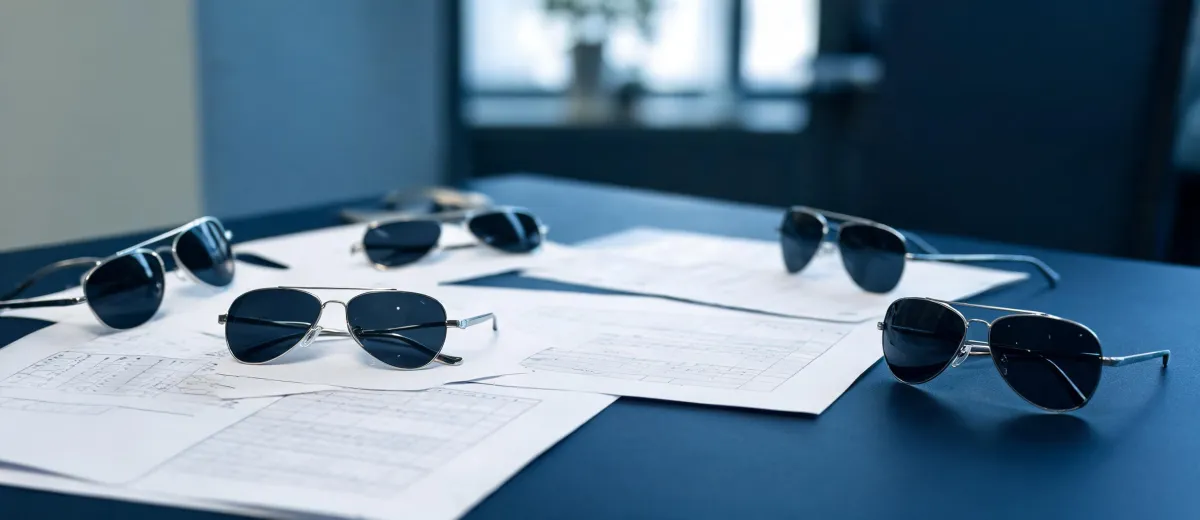
Two aviator sunglasses can look the same in a supplier's catalog photo and differ by $4.80 per unit in real cost. That gap comes from things you can't see in a JPEG.
Take black aviator sunglasses — one of our highest-volume categories. On a recent sourcing round for a men's black aviator SKU, I collected quotes from five suppliers. The unit prices ranged from $3.10 to $7.40, FOB. That's a 139% spread for what every supplier described as "classic black aviator, metal frame, UV400 lens."
When I asked each supplier to fill out the same specification sheet — frame material, hinge type, lens material, lens coating, temple tip construction, and certification documents — the spread collapsed into five completely different products:
- The $3.10 quote used a copper-alloy frame with single-screw hinges and TAC polarized lenses with no anti-scratch coating.
- The $7.40 quote used a monel frame, German OBEs, nylon lenses, and shipped with ANSI Z80.3 test reports and EU accessory documentation.
The $4.30 gap isn't a markup difference. It's a different product. And if you're selling gold aviator sunglasses into a market where customers expect a certain weight and hinge feel, the $3.10 version will generate returns that erase the savings within one quarter.
Reason 2: Lens Coating Is Where Cheap Quotes Quietly Fall Apart
This one caught me off guard, and it's the most counterintuitive lesson from my first three years of sourcing.
I assumed lens quality differences showed up immediately — cloudy optics, distorted edges, that sort of thing. They don't. The cheap lens looks fine on day one. What fails is the coating, and it fails on a delay of 60 to 120 days.
On polarized aviator sunglasses, the cost difference between a properly applied hydrophobic/anti-scratch coating stack and a thin single-layer spray is small at the factory — often under $0.40 per lens. But it's the difference between a product that survives a customer's beach vacation and one that comes back as a chargeback with a photo of a peeling lens.
In 2023, we ran a side-by-side test: 200 units of a $4.10 polarized aviator from Supplier A, 200 units of a $5.60 equivalent from Supplier B, both sold through the same online channel over one summer. The $4.10 version generated a 7.5% return rate on coating-related complaints. Supplier B's version generated 1.2%. At our average selling price and return-processing cost, the cheaper unit lost us roughly $610 on the 400-unit run — more than the entire price difference.
I don't have a clean industry-wide benchmark for this — I wish I'd tracked coating failures across every SKU from the start. What I can say from our own records is that coating complaints are the single most common quality issue we've seen on lower-priced aviator frames, and almost none of them appear in the first 30 days.
Reason 3: The MOQ Trap Nobody Prices Correctly
Here's the part that gets ignored in most sourcing comparisons: minimum order quantities are a cash cost, not just a flexibility question.
Look at aviator sunglasses for women — a category where color trends move faster than men's aviators, and where gold aviator sunglasses and rose-tinted variants cycle in and out of demand within a single season. A supplier quoting $4.80 at 1,200 pieces MOQ looks better per unit than one quoting $5.50 at 300 pieces. But if you only move 350 units of that rose-gold variant in the season, you're carrying 850 units of dead stock, plus the working capital locked in inventory, plus the warehouse space.
I built a simple rule into our tracking sheet after getting burned on a 2022 overstock situation: every quote gets an "effective landed unit cost" that includes carrying cost on unsold inventory assuming a realistic sell-through rate for that colorway. In our experience, for trend-sensitive aviator colors, the higher-MOQ quote needs to be at least 18–22% cheaper per unit to justify the inventory risk. Anything less and you're paying for the supplier's efficiency with your own cash flow.
An informed buying decision isn't the one with the lowest number in the quote. It's the one where you understood every number that wasn't in the quote.
"But We're a Small Brand — We Can't Afford to Overthink This"
Fair pushback, and I hear it often. If you're placing a 100-piece test order for a new aviator sunglasses sourcing program, you don't need a 12-tab TCO model. But you do need three things in writing before you pay a deposit:
- The lens specification, itemized. Base material, polarization method, coating layers, and the UV standard the lens is tested against (ANSI Z80.3 in the US, EN ISO 12312-1 in the EU). "UV400" is a marketing term, not a test result — ask for the actual test report, not a claim on the spec sheet.
- The hinge and frame material, named. "Metal frame" can mean four different alloys. If the supplier won't name it, the answer is usually the cheapest one available.
- A written return/rework policy on lens defects. If the supplier won't commit to replacing units with coating failures within 90 days, you're absorbing their quality risk.
None of that requires a spreadsheet. It requires ten minutes and a refusal to accept vague answers.
The Point Isn't to Distrust Suppliers. It's to Price the Full Product.
I'd rather spend an extra 40 minutes per sourcing round documenting specifications than spend a quarter managing returns and chargebacks. That's the whole philosophy: an informed buyer asks better questions, catches the gaps earlier, and ends up with fewer unpleasant surprises on the invoice.
The aviator sunglasses category is full of products that look identical and perform completely differently — that's not a knock on any supplier, it's just the reality of a category where a lens coating costs pennies and a returned order costs thousands. So compare quotes on the specification sheet before the price sheet. If the specs line up, the price comparison will actually mean something.
If they don't line up, you're not comparing vendors. You're comparing marketing.