The $4,000 Aviator Batch That Made Me Rewrite Our Entire Spec Sheet
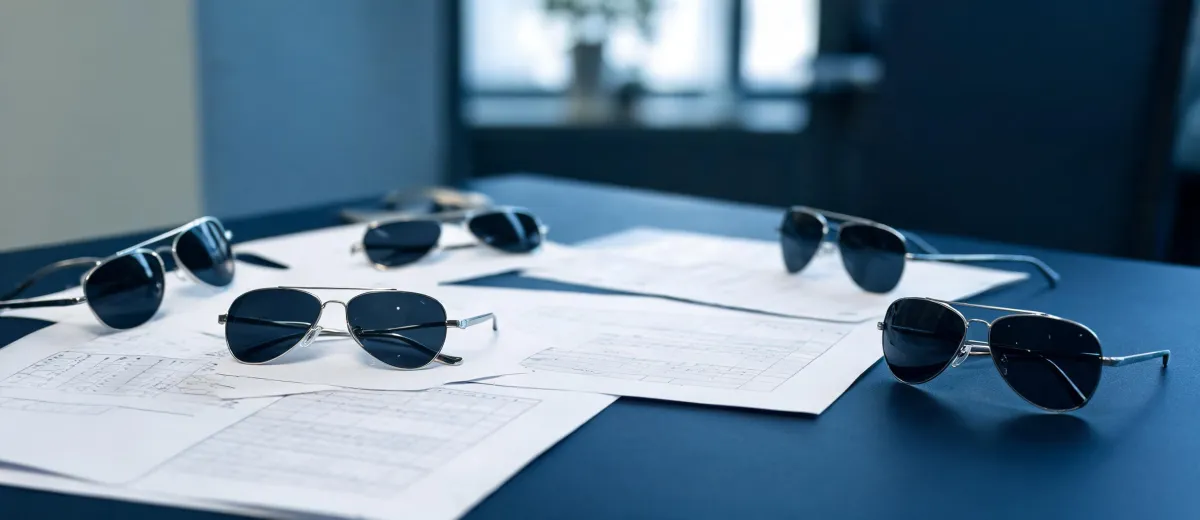
I still remember the Tuesday in early 2023 when 2,800 pairs of men's aviator sunglasses landed in our warehouse and something felt wrong before I even opened the first carton. The shipment weight was lighter than the quote sheet said it should be—about 40 kilograms off across the pallets. That's the kind of thing you notice when you've weighed enough inventory.
I'm the quality and brand compliance manager for a mid-size eyewear importer. I review every bulk order before it reaches our retail partners—roughly 320 SKUs a year, and about 40% of those are aviator styles in some variation (gold aviator sunglasses, black, polarized, women's sizing, men's sizing, you name it). Over four years of doing this, I've rejected about 18% of first deliveries. That day was about to become one of them.
The background: why we started sourcing aviator sunglasses directly
To give you context—until 2021, we bought through a US-based wholesaler. Margin was thin, MOQ was high, and we had zero flexibility on frame color or lens tint. When we moved to direct OEM sourcing in late 2021, it was the right call for us. But I underestimated how much work it would add to my plate.
Our first direct order was simple: 500 units of gold aviator sunglasses, unisex sizing, non-polarized, one lens color. No problems. Second order, 1,200 units of polarized aviator sunglasses in a men's cut—a few minor issues, nothing that made me lose sleep. The third order is where things got interesting.
The order that changed how I write spec sheets
The shipment that arrived that Tuesday was supposed to be our biggest aviator order to that point: 2,800 units across four SKUs. We'd ordered aviator sunglasses for men in gold and black, plus aviator sunglasses for women in the same colorways but 3mm narrower. All four were labeled UV400—which, by the way, is a common marketing standard indicating lenses that block wavelengths up to 400 nanometers. It's not a certification and it doesn't guarantee anything on its own, but it's the baseline every buyer expects. All four had the same teardrop lens shape we'd approved on the sample.
Here's what I found in the first two hours of inspection:
- Weight per unit was off. Individual pairs averaged 22 grams against the 26 grams on our approved sample. A 15% deviation—way outside the ±8% tolerance we'd specified.
- Gold frame color didn't match. Sitting next to the approved Pantone chip, the shipment read more bronze than gold. Our Delta E reader was showing values around 4.1. For context, Pantone's own color matching guidelines treat Delta E below 2 as imperceptible and values above 4 as visible to most people. So this wasn't a nitpick.
- Hinge asymmetry. On 3 out of 50 randomly pulled samples from one SKU, the left and right temple opened to noticeably different angles—roughly 8 degrees apart. Not a deal-breaker for most buyers, but a red flag for a brand selling through optical retail.
And then there was the polarization. That one took another week to catch.
The polarization issue that nearly slipped through
If you've ever sourced polarized aviator sunglasses, you know the inline test: a card or a screen you look through. If the lens goes black when you rotate it 90 degrees, it's polarized. The problem is that test only confirms presence of polarization, not quality of it.
I didn't catch it on the first pass. A colleague asked me to try on a pair while driving to a trade show and complained that the road glare looked "wavy." When I got back, we sent 20 pairs to a third-party lab for axis verification.
Results came back about ten days later: 14% of the tested samples had polarization axis more than 5 degrees off. That's where the ghosting starts—the visual interference most people notice before they can name it. For a men's aviator sunglasses line we'd explicitly marketed toward driving and outdoor wear, that mattered.
"Look, that's within industry standard." — the factory's first response when I sent the lab report.
It wasn't, and I had to point to specific standards to explain why. ANSI Z80.3 (the US nonprescription sunglasses standard) and ISO 12312-1 (the international equivalent) both lay out transmission and polarization requirements our spec sheet had referenced from day one. Our contract didn't specify axis tolerance explicitly—a mistake I'll get to in a minute—but it did require conformance with both standards.
The gut-vs-data moment
Here's where I want to be honest about a call I almost got wrong.
The factory offered to rework about 60% of the order—re-do the gold anodizing, swap the bad hinge assemblies, and re-run lens inspections at their cost. On paper, that was the smart move. Switching to a second vendor mid-season would cost us roughly $2,000 more per SKU between new tooling and expedited freight. The math clearly said: accept the rework.
My gut said the rework would be sloppy. Not because of anything the vendor had said directly, but because their timeline was aggressive—three weeks for a process that had originally taken five.
I went with my gut. We accepted rework on the two SKUs with relatively minor issues, pushed the other two to a second supplier, and ate the margin hit. Our 30% deposit on the rejected SKUs—about $4,000—was tied up in dispute for eleven weeks while we sorted out who owed what.
The vendor's rework came back on time. Quality was fine. I was wrong about the sloppiness. But when I pulled six months of order history after that, I noticed a pattern. This factory did great work on rework and mediocre work on first production runs whenever they were rushed. So my gut wasn't reading the vendor's honesty wrong—it was reading the timing wrong. I'd assumed three weeks meant sloppy. It actually meant "we'll pull resources from other orders," which they did, and which worked. It just wasn't a strategy I could lean on long-term.
What I actually changed
It took me about two years and roughly 150 aviator orders to understand the real lesson buried in that batch. The spec sheet was never going to be enough. What I needed was a verification protocol that runs at the factory before shipment, not at my warehouse after.
Here's what we built, and what I'd recommend to any B2B buyer scaling aviator sunglasses sourcing:
- Pantone reference under defined lighting. We now require the factory to photograph the finished frame against the approved Pantone chip under D65 lighting and send it before packing. This kills about 80% of the color disputes I used to have, because nobody's arguing about what "gold" means anymore.
- Weight tolerance of ±5% per SKU. The weight check caught that lighter-batch issue immediately. Cheap scales at the factory plus a signature on the spec sheet do more than any legal clause.
- Polarization axis stated explicitly as a number. ±3 degrees, verified on a 10% sample per SKU by an independent lab. This is the one line item where "trust but verify" gets expensive fast, but it's worth it if you're selling polarized aviator sunglasses under your own brand.
- Third-party AQL inspection at origin. Not a full inspection—just an AQL 2.5 check on assembly, hinge alignment, and finish. Runs about $200-$350 per SKU depending on volume (as of early 2025, at least), and catches the failures that matter.
The most frustrating part of aviator sourcing for me wasn't the rejected batch. It was the two years that followed where new problems kept showing up in different forms—color matching one quarter, hinge tension the next—and I kept patching the spec sheet instead of rebuilding it. You'd think written specs would prevent misunderstandings, but interpretation varies wildly until you make the numbers non-negotiable.
Where aviator sunglasses sourcing might not work for you
I want to be honest about limitations, because I've been on the wrong side of "this solution works for everyone" recommendations more than once.
Direct OEM aviator sourcing works really well for B2B buyers who are:
- Ordering 500+ units per SKU (below that, MOQs squeeze your margin)
- Comfortable with 45-75 day production and freight timelines
- Willing to invest in third-party inspection and lab testing on the front end
- Selling to buyers whose quality bar is "consistently good and well-presented," not "collector-grade"
It works less well for buyers who are:
- Selling at premium optical retail with a $180+ price point (the buyer will notice the 8-degree hinge, and honestly so will the salesperson behind the counter)
- Needing same-quarter style refreshes (you just can't turn an OEM aviator pipeline that fast)
- Not set up for in-house QC (if you're not going to inspect, the factory's word gets you about 80% of the way, and the other 20% is where you lose customers)
If you're in that second group, sourcing through a US or European wholesaler with markup is a perfectly good business decision. It isn't "leaving money on the table" if the money is being spent on QC you're not doing.
Bottom line
I used to think my job was catching bad aviator sunglasses before they left the warehouse. Four years and a lot of rejected batches later, I think my job is making the spec sheet specific enough that "catching" isn't really needed. That shift took an entire rejected bulk order to absorb.
If you're starting out with aviator sunglasses sourcing, my advice is: build the spec sheet like your worst case is the default case. Agree on numbers—Delta E, grams, degrees—not adjectives. And when the factory says "within industry standard," ask which standard and which clause. Half the time, the answer will make the next shipment better.